

Four out of ten newly promoted managers and executives fail within 18 months of taking a new role. The research has held at that number for at least 15 years. The landmines are the same across industries and levels: culture, relationships, stakeholder expectations, and the absence of a structured transition architecture. The cost of failure has been calculated at between two and twenty times total compensation. The opportunity cost is larger still and almost never measured.
This piece examines why the number has not moved, what the failure patterns are, and what a structured leadership capability journey looks like when an organisation decides to treat the transition problem seriously.
The failure rates by role
When first promoted or recruited, the following executive populations experienced the highest failure rates within the first 18 months: senior-level executives (39%), sales executives (30%), marketing executives (25%), and operations executives (23%).
The major reasons for failure in the new role
- 75% fail to establish a cultural fit
- 52% fail to build teamwork with staff and peers
- 33% are unclear about what their managers expect
- 25% lack the required internal political awareness
- 22% have no structured process to assimilate into the new accountability
Notice that none of these are about functional competence. The leaders who fail within 18 months are not failing because they cannot do the technical work of the role. They are failing because the organisation promoted them without addressing the leadership transition — the shift from functional expert to someone who delivers through others, navigates ambiguity, and builds trust across the hierarchy.
It is expensive. The cost of failure for an executive can be catastrophic, relegating them to survival roles after a failure. The cost of failure for an organisation has been calculated at somewhere between two and twenty times total compensation — not including the far larger opportunity costs.
We are not making the progress we need to make
People are still tripping over the same landmines: organisation, role, personal, learning, relationships, delivery and adjustment. And the failure rates are the same. Fortune’s Anne Fisher notes that research “has stood at about 40% for at least 15 years now” in her article “New Job? Get a Head Start Now.”
Progress is possible if the organisation treats it as a design problem
McKinsey research, published in Leading Organizations: Ten Timeless Truths, identified five areas where executive transitions succeed or fail. The five areas are consistent across industries and levels:
- Yourself: Does the leader understand what drives them, what their default patterns are under pressure, and what legacy they are building?
- Team: Do they have the right people around them, and are they leading those people toward performance?
- Culture: Do they understand the operating culture they have inherited, and are they consciously shaping it?
- Other Stakeholders: Have they mapped the expectations of the people whose support they need, and built enough trust to be given time to deliver?
- Business context: Do they have a clear grasp of current performance and have they aligned their team around a coherent set of priorities?
An organisation that invests in a LEAP Leadership Journey built around these five transitions produces a measurably different outcome. The leader is not left to discover the landmines. The development architecture addresses them deliberately, before the 18-month window closes.
Leadership is an intentional process of being and becoming. At its best, leadership is the ability to create and sustain the conditions for people and the organisation as a whole to thrive. It is a journey of change without a pause, because a true leader is always work-in-progress.
LEAP — Leadership Excellence through Awareness and Practice
An outcomes-based bespoke leadership mastery journey. Leadership happens at multiple levels: Self, Team, Organisation. For leadership to be authentic, the leader’s journey has to be inside-out, rather than outside-in. This requires leaders to be self-aware and to constantly work on themselves, so that they lead by action, not by position.
The genesis of the LEAP construct rests on two findings. First: a single or series of disjointed interventions, however well-meaning and designed, does not lead participants to make significant changes in their behaviours. A series of interconnected experiences is critical to help new leaders succeed. Second: leadership is a skill that needs to be purposefully practised. This means building conscious 360-degree engagement with the participant throughout the developmental journey.

Components of the LEAP Journey
- Pre and Post Assessments: The journey begins with a comprehensive assessment of the leaders’ strengths and development areas. Regular post-assessments measure progress and identify areas for improvement.
- Periodic Self-Assessment Inventories: Leaders reflect on their growth, challenges, and successes through self-assessment inventories, fostering self-awareness and continuous improvement.
- 360-Degree Multi-Sensory Modular Learning: Diverse learning methods appealing to various learning styles. Workshops, interactive sessions, and simulations keep the experience engaging, impactful, and application-driven.
- Masterclasses and Facilitated Immersion: Leaders gain hands-on experience in real-life scenarios, learning from both successes and setbacks. Reflection sessions deepen the learning process.
- Partners at Learning for FeedForward: Peers, direct reports, and mentors become Partners at Learning, providing valuable input for continuous growth.
- RISES Action Learning: Leaders identify specific behaviours they want to develop and, through consistent practice and support, make meaningful changes.
- Six to Nine Structured Coaching Sessions: One-to-one coaching sessions provide personalised guidance, enabling leaders to overcome challenges and refine their leadership behaviours.
- 24×7 Journey Mentor Access: Ongoing access to a mentor throughout the journey ensures continuous support and accountability.
The LEAP Modular Approach
A — 360-Degree Multi-Modal

B — Inside-Out Modular Capability Development

The LEAP Leadership Capability Development Outcomes

ProventusHR has delivered 15 LEAP journeys across diverse organisations. Participants have demonstrated measurable qualitative and quantitative improvements in leadership behaviours. Learning effectiveness evaluation scores have consistently ranked in the high 90th percentile.
The Evidence
A — Pre and Post Psychometric Assessment Scores

B — 360-Degree Leadership Growth Progress Feedback

C — Manager Verbatim Feedback
“The Executive has taken the feedback positively and I have seen her work towards that. She has become more realistic in terms of expectation setting and thus helped build a better working relationship with her team. She has taken clear actions to build closer relationships with her team members and brainstorm how to provide feedback.”
“I have noticed The Executive being more vocal of his opinions and recommendations, defending those in a logical manner even if the audience in the room thinks otherwise. He has managed time more efficiently and ensured regular checkpoints are present.”
“The Executive has become better at communicating the vision of a project and driving the team towards working collaboratively as a single unit. His ability to bring together the efforts from different team members into a final deliverable has been helpful for the team.”
“The Executive has taken more ownership and demonstrated higher confidence, overall team management and delegation including growing strengths of his reports, better mid and high-level client communication and management. His voice has become stronger in leadership discussions, his guidance more clear, and I have seen the productivity of his team increase despite challenging headwinds under his leadership.”
E — Industry Recognition
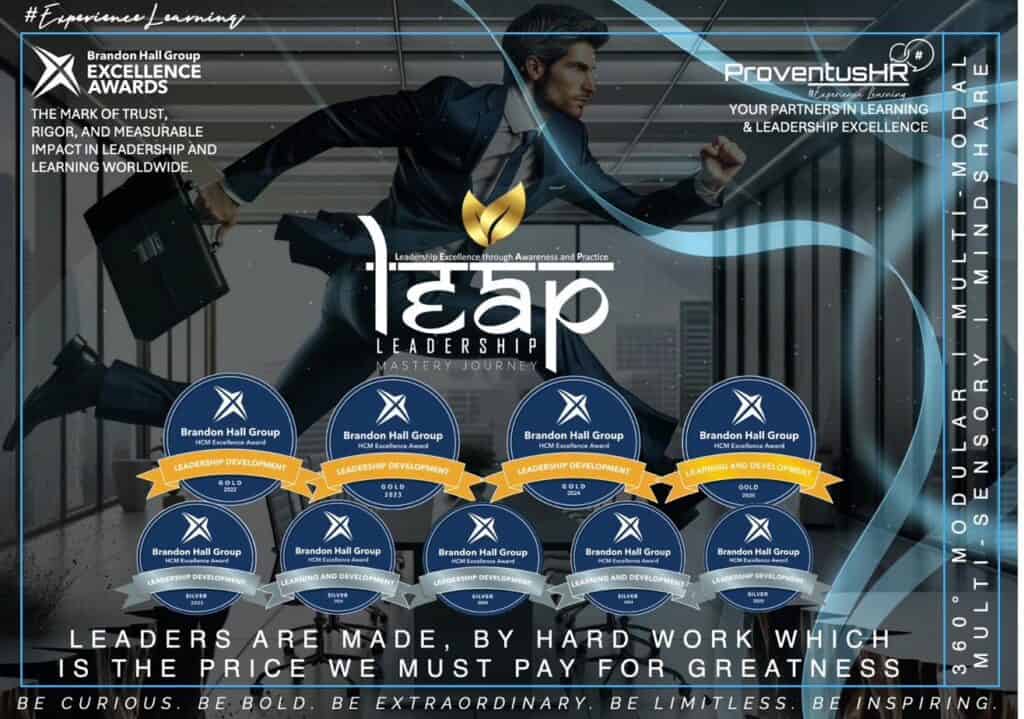
ProventusHR’s LEAP Leadership Mastery Journey has been recognised with nine Brandon Hall HCM Excellence Awards for Leadership Development between 2022 and 2025.
Free Resource
The Experiential Leadership Playbook
28 pages on why most leadership programmes fail to produce lasting behaviour change, and the design principles that produce the outcomes the 40% statistic says are missing. Downloaded by L&D leaders and CHROs across India and the GCC.
Download the Playbook
About the Author
Founder Director, ProventusHR · MGSCC Master Coach · NDA Alumnus
Founder of ProventusHR and principal architect of ExperienceLearning and REEL|Life. 25+ years across leadership advisory, executive coaching, and experiential design across 14 industries. 9x Brandon Hall HCM Excellence Award winner (2022 to 2025).
Full Profile ›