

The Leadership Development Choice Is More Structural Than It Appears
Over three decades, I have experienced leadership development from both sides of the table.
I have sat with business and HR leaders evaluating providers, testing programme relevance, examining commercial value, and asking whether an intervention would genuinely change how leaders think, decide, collaborate, and act.
I have also worked on the advisory side, diagnosing organisational challenges, designing leadership journeys, facilitating difficult conversations, coaching senior leaders, interpreting stakeholder feedback, and remaining accountable beyond the formal programme.
That experience has led me to a simple conclusion:
The decision is rarely about whether a provider is capable. Most credible providers are.
The more consequential questions are:
Who understands the context?
Who remains present through the journey?
Who adapts the design as circumstances evolve?
Who remains accountable for the outcome?
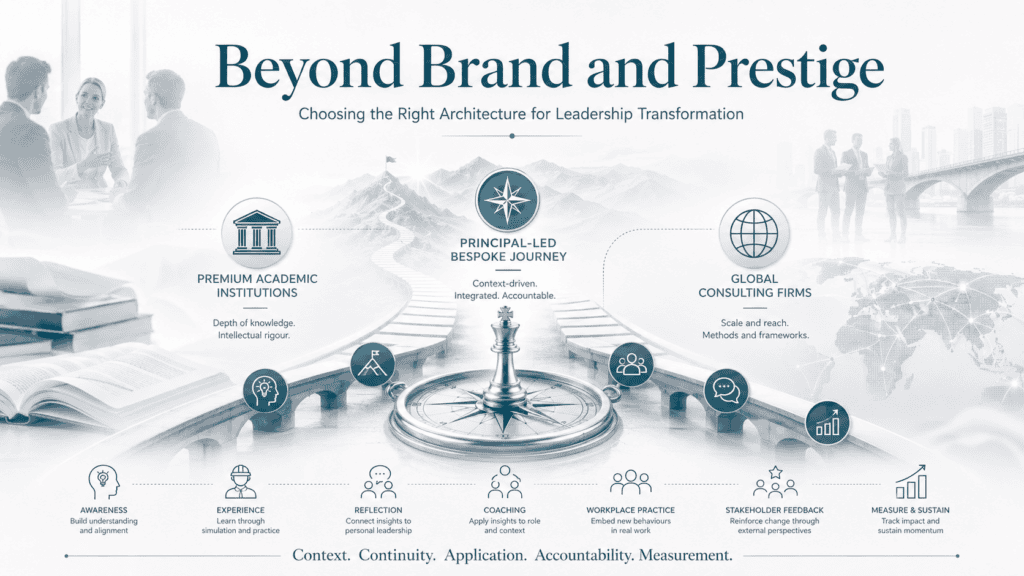
Most significant leadership development investments fall into three broad models:
- Principal-led bespoke advisory, where the person diagnosing and designing the intervention remains closely involved through delivery, application, and review.
- Global consulting firms, built for scale, established methodologies, extensive benchmarking, and multi-market deployment.
- Premium academic institutions, offering faculty expertise, intellectual rigour, peer exposure, and recognised credentials.
Each model has a legitimate role. The more useful task is to understand the structural logic of each and determine which best fits the outcome being sought.
The evidence suggests that leadership development succeeds not because of brand or content alone, but because of context, continuity, application, accountability, and measurement.
Context Is the First Design Principle
McKinsey Quarterly’s widely referenced analysis, Why Leadership-Development Programs Fail, identifies overlooking organisational context as a major reason programmes underperform.
Organisations often begin with competency frameworks, module catalogues, or established curricula. The more important starting point is the organisation’s strategy, culture, leadership history, operating environment, and immediate business mandate.
McKinsey illustrates this through a European retail bank whose sales managers did not primarily require generic communication training. Their critical capability gap was more specific: influencing peers without formal authority.
Once the intervention was redesigned around that need, productivity reportedly improved by 15 percent.
The implication is clear:
Leadership development underperforms when leadership is treated as generic knowledge rather than behaviour exercised within a specific strategic and cultural environment.
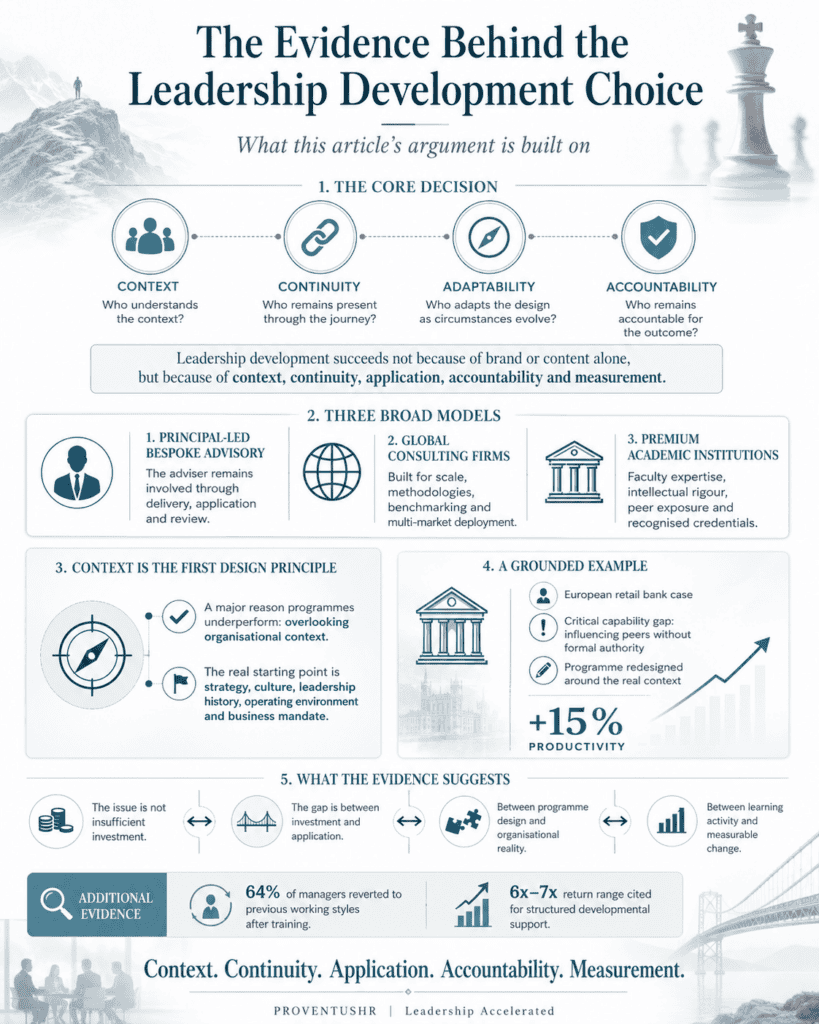
The issue is not insufficient investment. It is the gap between investment and application, between programme design and organisational reality, and between learning activity and measurable change.
Where Each Model Creates Distinctive Value
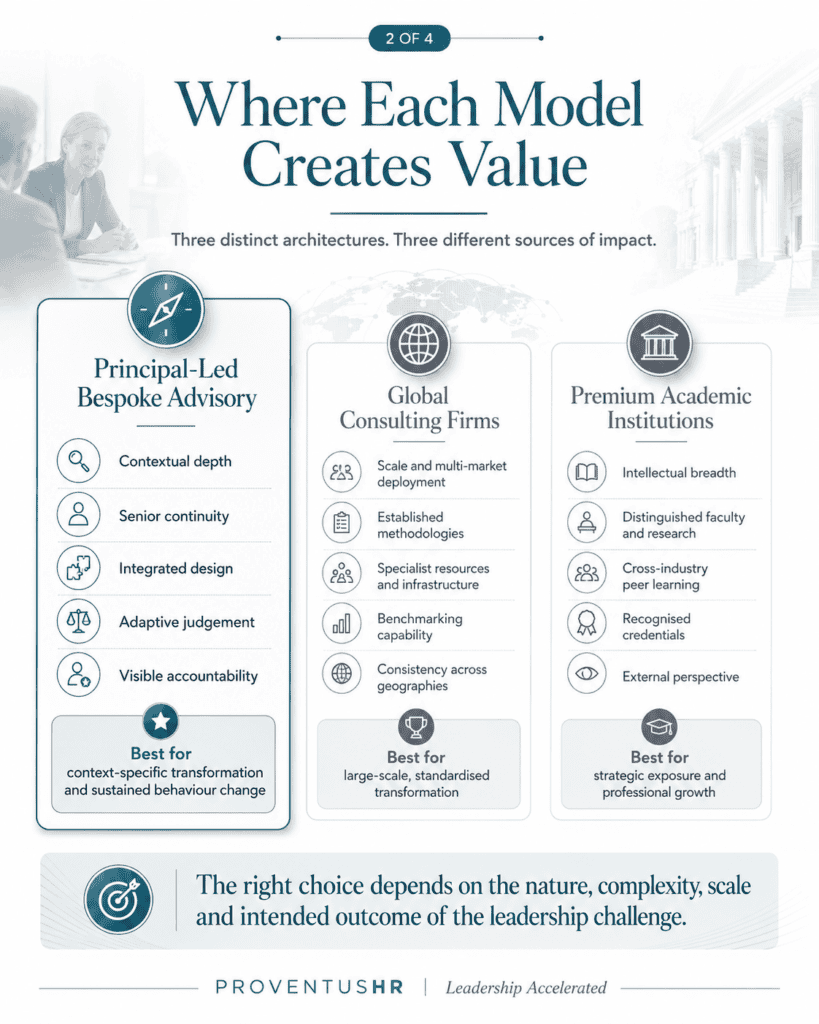
The three models are not interchangeable. Each is designed around a different source of value and becomes more compelling under different organisational conditions.
Premium Academic Institutions: Intellectual Breadth and External Perspective
Premium academic institutions provide access to distinguished faculty, established research, cross-industry perspectives, peer networks, and recognised credentials.
They are particularly valuable when the objective is to:
- broaden strategic and intellectual perspective;
- create exposure to diverse industries and business models;
- provide a recognised academic credential;
- build an external professional network;
- offer reflective space away from immediate organisational demands.
For leaders seeking conceptual breadth, professional recognition, and cross-industry learning, the academic model can be highly effective.
Its principal limitation lies not in the quality of learning, but in the distance between the learning environment and the workplace in which behaviour must change.
Participants return to the same reporting relationships, operating pressures, incentives, habits, and stakeholder expectations that existed before the programme. Without structured application, manager involvement, coaching, peer accountability, and stakeholder feedback, even high-quality learning may struggle to translate into sustained workplace behaviour.
Research on learning transfer reinforces this concern. Santos and Stuart’s 2003 study found that 64 percent of managers reverted to their previous working styles after training.
This helps explain why many business schools are increasingly embedding live business challenges, action learning, applied assignments, and coaching into executive education.
The underlying principle remains:
Knowledge creates possibility. Application, feedback, and reinforcement determine whether that possibility becomes behaviour.
Global Consulting Firms: Scale, Infrastructure, and Deployment Capacity
Global consulting firms create value through scale, established methodologies, specialist resources, benchmarking capability, and coordinated delivery across markets.
They are particularly well suited when the requirement involves:
- simultaneous implementation across multiple countries;
- standardisation across business units;
- multilingual facilitation;
- large-scale programme administration;
- access to extensive normative data;
- rapid mobilisation of specialist teams;
- integration with broader organisational transformation.
Their operating model allows complex programmes to be deployed consistently across large populations and geographies. This becomes especially valuable when the organisation requires reach, speed, comparability, and central governance.
The potential limitation is that senior involvement at the diagnostic or proposal stage may not always translate into equivalent continuity during delivery. Responsibility may move across partners, project managers, facilitators, and specialists.
The delivery team may be highly capable, but its understanding of the client’s leadership context can become transferred rather than directly experienced.
For highly standardised, geographically distributed, or data-intensive requirements, this trade-off may be entirely appropriate. Global consulting firms are therefore strongest when deployment capacity and consistency across markets are central to the mandate.
Principal-Led Bespoke Advisory: Contextual Depth and Senior Continuity
Principal-led bespoke advisory creates value through contextual intimacy, sustained senior judgement, integrated design, and visible accountability.
It is particularly valuable when the challenge involves:
- sensitive leadership or stakeholder dynamics;
- a distinctive organisational culture or history;
- leadership transitions;
- complex behavioural or relational issues;
- enterprise-level capability building;
- integration between leadership development and business priorities;
- adaptation as circumstances evolve;
- sustained accountability for behavioural change.
The defining feature is that the same senior adviser remains closely connected to the engagement from diagnosis through design, delivery, application, and review.
This continuity matters because organisational context is not merely information. It includes what was said, what remained unspoken, where perspectives diverged, where trust is fragile, and which leadership behaviours carry historical significance.
These realities are difficult to reconstruct fully through handovers.
A principal-led model therefore offers continuity of:
- context, because diagnostic insight is retained;
- judgement, because the journey can be recalibrated in real time;
- relationship, because trust and candour deepen over time;
- accountability, because responsibility remains visible.
Its honest limitation is capacity. The model requires disciplined availability, clear governance, documented architecture, and an appropriate network of co-facilitators, coaches, and specialists.
When governed well, it creates a rare combination:
Senior continuity without operational fragility, personal accountability without loss of specialist depth, and bespoke design without fragmentation across the journey.
From Interventions to a Structured Leadership Capability Journey
Leadership capability is rarely built through a single workshop, an isolated academic module, or a series of coaching conversations.
The stronger architecture is a structured leadership capability-building journey that combines:
- context-specific capability inputs;
- experiential learning and simulations;
- application to live business challenges;
- executive coaching;
- peer reflection and accountability;
- manager and stakeholder involvement;
- measurement of behavioural and business outcomes.
Each element performs a distinct role.
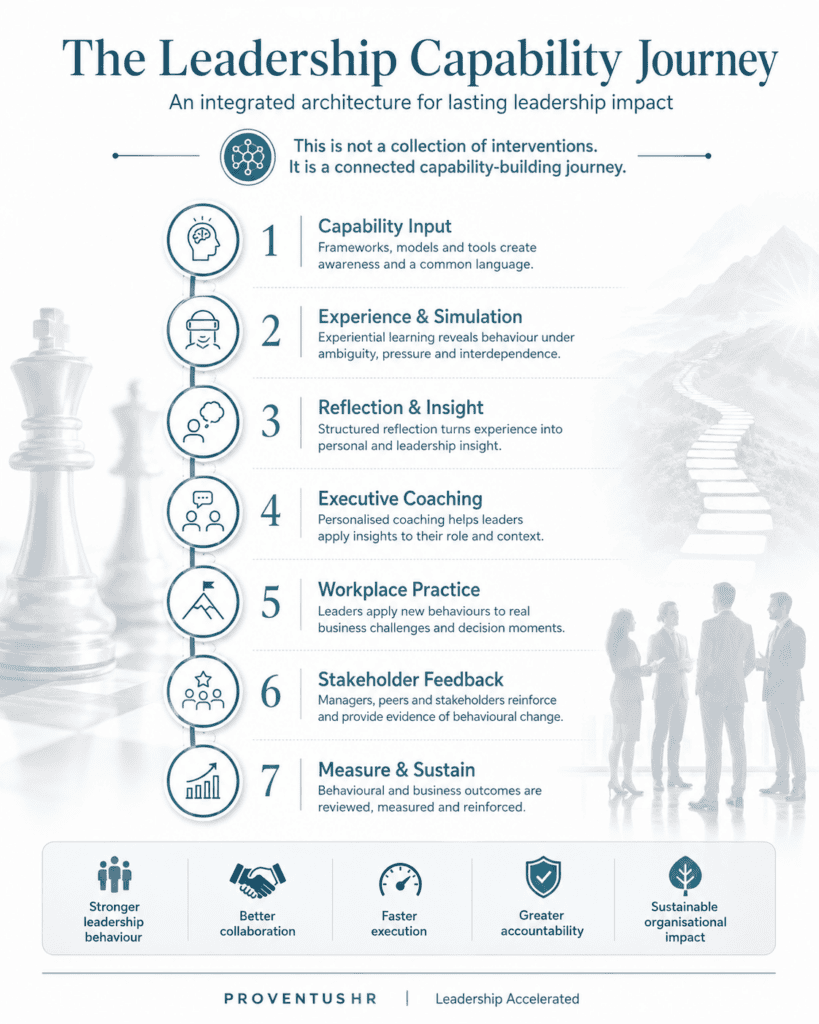
Capability inputs provide frameworks and a common leadership language.
Experiential interventions reveal behaviour under conditions of ambiguity, pressure, and interdependence.
Live business application connects learning to organisational priorities.
Executive coaching becomes the personalisation and application mechanism within the wider journey, helping leaders interpret common capability themes through the lens of their own roles and behaviours.
The journey follows a deliberate progression:
Capability input creates awareness.
Experience reveals behaviour.
Reflection creates insight.
Coaching enables personal application.
Workplace practice builds new habits.
Stakeholder feedback confirms whether change is visible.
This is not a collection of interventions. It is an integrated environment in which leaders repeatedly move between learning, experimentation, reflection, application, and feedback.
The Benefits of an Integrated Journey
A structured capability journey creates several advantages.
A Common Leadership Language
Leaders develop shared expectations around accountability, collaboration, decision-making, inclusion, influence, and enterprise leadership.
Contextual Relevance
The journey reflects the organisation’s strategy, culture, business priorities, and future capability requirements.
Personalised Development
The capability architecture remains common, while executive coaching allows each leader to focus on the few behaviours that matter most.
Stronger Workplace Transfer
Repeated application, reflection, and feedback strengthen the shift from conceptual understanding to workplace behaviour.
Sustained Accountability
Coaching, peer partnerships, manager conversations, and stakeholder reviews keep development alive between formal learning moments.
Organisational Alignment
The journey shapes not only individual capability, but also shared expectations about how leaders decide, collaborate, confront difficulty, and lead across boundaries.
Observable Change
Stakeholders provide evidence of whether agreed behaviours are becoming more visible and consistent.
Business Relevance
Leaders apply their learning to priorities such as faster execution, stronger collaboration, customer orientation, ownership, transformation, and talent development.
Leadership capability building therefore becomes connected to how the organisation performs, rather than remaining a parallel HR initiative.
What the Evidence Contributes
Research associated with executive coaching is most useful when interpreted within the broader architecture of sustained leadership capability building.
A widely cited Manchester Inc. study followed 100 executives through developmental engagements lasting six months to one year and linked to identified business objectives.
The study reported an average return approaching six times the investment, with improvements across productivity, quality, customer service, and executive retention.
The International Coaching Federation’s Global Coaching Client Study also reported a median organisational return of approximately seven times the investment among organisations that formally measured return.
The more useful conclusion is not that coaching alone produces transformation.
It is that leadership development creates greater value when it is:
- sustained rather than episodic;
- connected to business priorities;
- personalised to the individual leader;
- reinforced through workplace application;
- reviewed against observable outcomes.
Within a structured journey, executive coaching helps leaders interpret capability inputs, recognise behavioural patterns, apply new approaches to live challenges, and remain accountable between formal learning moments.
Stakeholders as the Measure of Change
The principles underlying Marshall Goldsmith Stakeholder Centered Coaching also strengthen a broader capability-building journey.
Its contribution lies in making leadership change:
- behaviourally specific;
- visible to others;
- reinforced through repeated action;
- reviewed through stakeholder feedback;
- measured by those who experience the leader’s behaviour.
Published findings across more than 11,000 executives have reported that 95 percent of leaders who completed the process demonstrated measurable improvement, as assessed by their stakeholders.
The core discipline is powerful:
The leader does not determine whether meaningful change has occurred. The stakeholders who experience the behaviour do.
Stakeholders help identify the behaviour that matters most, reinforce application over time, and provide credible evidence of change.
The participant does not independently declare success.
The coach does not independently declare success.
The provider does not independently declare success.
Leadership change is evidenced by whether stakeholders experience a difference that is visible, consistent, and meaningful.
A Side-by-Side Comparison
| Dimension | Principal-Led Bespoke Advisory | Global Consulting Firms | Premium Academic Programmes |
| Primary value | Contextual depth, continuity, integrated design, and accountability | Scale, methodology, and deployment capacity | Intellectual breadth, credentials, and peer exposure |
| Contextualisation | Built around the organisation’s strategy, culture, leadership realities, and evolving priorities | Established methodologies adapted to the client context | Curriculum designed around broader leadership themes |
| Continuity | The same principal remains involved from diagnosis through impact review | Depends on staffing model, team composition, and handovers | Typically concludes with programme completion |
| Application | Embedded through live challenges, coaching, experiential learning, and stakeholder involvement | Varies according to engagement design and implementation scope | Often participant-led unless customised reinforcement is included |
| Measurement | Can focus on stakeholder-confirmed behaviour and attributable business outcomes | Often based on project KPIs, surveys, and agreed programme measures | Commonly based on assessment, satisfaction, and completion |
| Primary risk | Key-person dependency and capacity constraints if not supported by robust governance | Context dilution and discontinuity between senior sponsorship and delivery | Limited workplace transfer without organisational reinforcement |
| Stronger fit | Context-specific transformation and sustained behaviour change | Large-scale, standardised, multi-market deployment | Strategic exposure, credentials, and cross-industry learning |
The Questions That Should Shape the Buying Decision
The choice should not begin with:
Which provider has the strongest brand?
It should begin with:
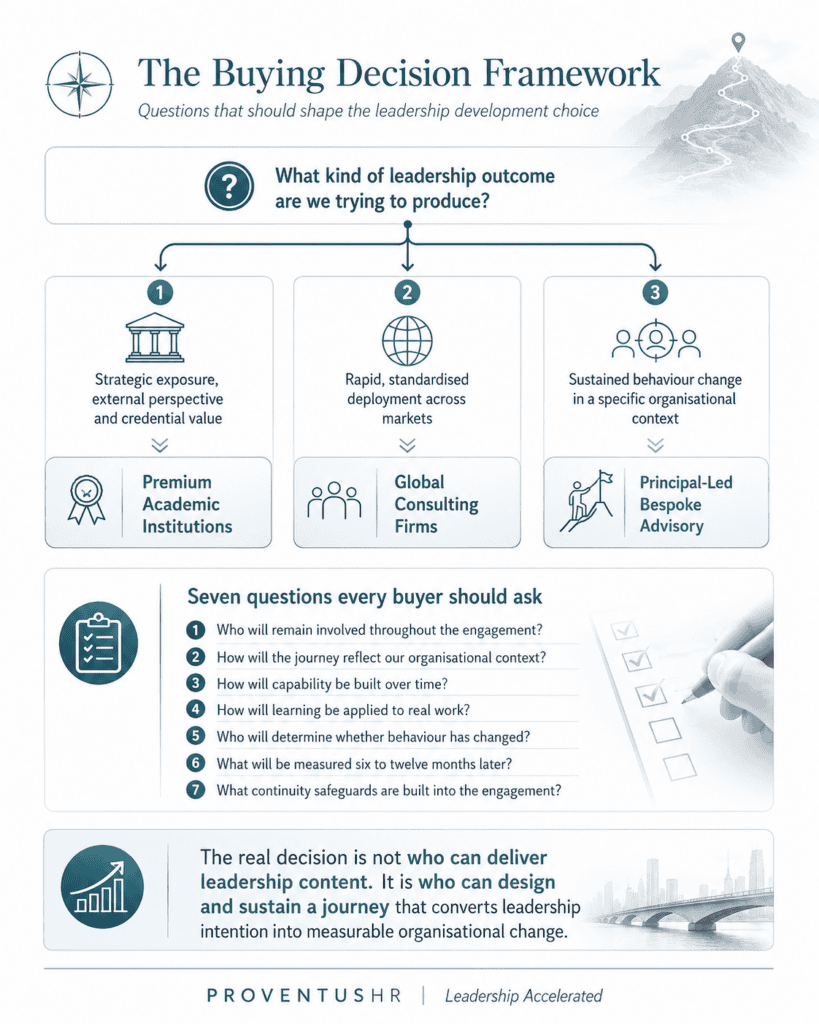
What kind of leadership outcome are we trying to produce?
For broad strategic exposure, credential value, and peer learning, an academic programme may be the strongest fit.
For rapid, standardised deployment across markets, a global consulting firm may be the more appropriate partner.
For sustained behaviour change in a specific organisational context, a principal-led bespoke advisory model may offer the stronger architecture.
The decision is not simply between a boutique, a global firm, and a business school.
It is between three different operating models for creating leadership value.
Before selecting a provider, organisations should ask:
Who will remain involved throughout the engagement?
How will the journey reflect our organisational context?
How will capability be built over time?
How will learning be applied to real work?
Who will determine whether behaviour has changed?
What will be measured six to twelve months later?
What continuity safeguards are built into the engagement?
These questions reveal more about likely impact than brand reputation alone.
The real buying decision is not simply who can deliver leadership content.
It is who can understand the organisation deeply enough, design an integrated capability journey, remain involved long enough, and accept sufficient accountability to convert leadership intention into sustained organisational change.
Where Each Model Genuinely Wins
| Model | Where It Creates the Greatest Value | Best Suited To | Principal Trade-Off |
| Premium Academic Institutions | Intellectual breadth, distinguished faculty, recognised credentials, and cross-industry exposure | Leaders seeking strategic perspective, external networks, professional recognition, and reflective distance from immediate operational demands | Learning may remain removed from the organisation’s specific context unless reinforced through workplace application, coaching, and stakeholder involvement |
| Global Consulting Firms | Scale, infrastructure, benchmarking, specialist resources, and consistent multi-market deployment | Large organisations requiring rapid mobilisation, standardisation across geographies, multilingual delivery, extensive programme management, and integration with wider transformation initiatives | Continuity of senior judgement may reduce as responsibility moves across partners, project teams, facilitators, and specialists |
| Principal-Led Bespoke Advisory | Contextual depth, sustained senior judgement, integrated capability architecture, and visible accountability from diagnosis to impact | Organisations seeking context-specific transformation, leadership alignment, behavioural change, and direct connection between capability building and business priorities | Capacity must be deliberately governed through principal availability, documented architecture, and a trusted network of specialist contributors |
The choice is therefore not between a larger or smaller provider, nor between prestige and personalisation.
It is between three distinct architectures for creating leadership value:
Academic institutions broaden perspective.
Global consulting firms enable scale.
Principal-led advisory converts context into a sustained, accountable journey from leadership intent to observable impact.
The strongest choice is the one whose operating model most closely matches the nature, complexity, scale, and intended outcome of the leadership challenge.
Conclusion
Leadership development is most likely to create lasting value when five conditions are present:
- The design reflects the organisation’s actual context.
- Senior leaders and stakeholders remain actively involved.
- Participants apply learning to real work.
- Accountability continues beyond the formal learning event.
- Behavioural and business outcomes are measured over time.
Global firms offer scale and deployment capability.
Academic institutions offer intellectual depth, credentials, and peer exposure.
Principal-led advisory brings together contextual insight, continuity of judgement, integrated journey design, personalisation, and visible accountability.
Where the challenge is distinctive, behaviourally complex, and closely connected to strategy and culture, the decisive requirement is rarely content alone. It is the ability to preserve context, build trust, adapt the journey, and sustain accountability as leadership behaviour is tested in the realities of work.
The case for principal-led advisory is therefore not that it is smaller or more personalised.
It is that the adviser who heard the original challenge, interpreted its implications, designed the response, and earned the trust of the organisation remains present:
when capability is being built,
when learning is applied,
when resistance emerges,
when behaviour is tested,
and when results are reviewed.
That is the difference between delivering a programme and accompanying an organisation through a leadership transformation journey.
Sources Referenced
- Gurdjian, P., Halbeisen, T., and Lane, K. “Why Leadership-Development Programs Fail.” McKinsey Quarterly, January 2014.
- Loew, L. and O’Leonard, K. Leadership Development Factbook 2012. Bersin by Deloitte.
- The State of Human Capital 2012: False Summit. The Conference Board and McKinsey.
- Gitsham, M. et al. Developing the Global Leader of Tomorrow. Ashridge Business School.
- Santos, A. and Stuart, M. (2003), research on post-training behavioural reversion.
- McGovern, J. et al. “Maximizing the Impact of Executive Coaching.” The Manchester Review, 2001.
- International Coaching Federation, Global Coaching Client Study.
- Marshall Goldsmith Stakeholder Centered Coaching, published programme research.