Netflix’s Ladies First is positioned as a gender-reversal comedy. It is something more uncomfortable: a moral experiment disguised as farce, and one of the most useful films available for any organisation serious about gender intelligence.

Netflix’s Ladies First, released on 22 May 2026, arrives with a premise that is almost deceptively simple. A charismatic, arrogant, entitled ladies’ man wakes up in a parallel world where women hold social, professional, sexual, and cultural power, while men are forced to navigate a reality built around someone else’s comfort. On the surface, it is a gender-reversal comedy. In truth, it is something more uncomfortable.
It is a moral experiment disguised as farce.
Because Ladies First is not really asking, what if women ruled the world? That would be too easy, almost too cartoonish. The sharper question is this: what happens when men are made to experience, even briefly and fictionally, the everyday humiliations that women have been expected to absorb with grace, humour, silence, and resilience?
That is where the film finds its sting. Not in the novelty of role reversal, but in the recognition that what looks absurd when done to men has long been normal when done to women.
INSIGHT | The Mirror the Film Holds Up
Entitlement dressed as confidence, conquest dressed as charisma
The man at the centre of the film is not an exceptional monster. That is precisely the point. He is familiar. He is charming enough to be excused, successful enough to be admired, casual enough to be forgiven, and self-assured enough never to examine the damage he leaves behind. He represents a particular kind of modern masculinity that does not see itself as oppressive because it has learned to package entitlement as confidence, conquest as charisma, and dismissal as banter.
Most men do not wake up each morning deciding to uphold patriarchy. We simply inherit its furniture and sit comfortably in it. We occupy rooms where our voices are heard sooner, our anger is interpreted more generously, our ambition is considered natural, our ageing is treated with more kindness, our bodies are policed less, and our mistakes are individualised rather than used as evidence against our entire gender.
This is the invisible architecture of privilege. It does not always feel like domination to those who benefit from it. It feels like normal life.
INSIGHT | The Workplace Inversion
Confusing being listened to with being right
One of the film’s most telling satirical moves is the workplace inversion. The man who once assumed that confidence would be mistaken for competence is now forced to earn attention in a room where attention is no longer structurally waiting for him. This is not merely a joke about a woman becoming the boss. It is a joke about how easily men confuse being listened to with being right.
In many offices, men are granted interpretive generosity. They can be half-prepared but still strategic, forceful but still passionate, repetitive but still visionary. Women, meanwhile, often have to arrive over-prepared just to be considered minimally credible.
Their authority is audited in real time. Their tone is monitored. Their anger is pathologised. Their ambition is treated as a personality issue.
Every woman knows the exhausting mathematics of being evaluated before being heard. Too much confidence, and she is arrogant. Too little, and she lacks leadership presence. Too assertive, and she is difficult. Too warm, and she is not serious. She must manage not only performance but perception. Not only work but tone. Not only competence but likeability.
Men often call this overthinking. Women call it survival.
- 2.6xmore likely to be interrupted in professional meetings: women versus men in equivalent roles, across multiple workplace observation studies
- 44%of women in McKinsey Women in the Workplace research reported being overlooked for a promotion or key assignment because of their gender
- 2–3xmore unpaid care and domestic work performed by women globally versus men, even in dual-income households. UN Women data.
INSIGHT | The Body, the Gaze, and the Grooming Sequence
What men rarely have to consider because it has been normalised as the cost of being socially acceptable for women
Men laugh at the male body being disciplined because male bodies are rarely treated as civic property. Women, by contrast, are raised into a relentless regime of correction. Hair must be removed. Skin must be managed. Age must be delayed. Clothes must signal enough attractiveness to be approved, but not so much as to invite blame. Beauty is demanded, then weaponised against them.
The grooming sequence in the film is not just a joke about pain. It is a satire of the pain men rarely have to consider because it has been normalised as the cost of being socially acceptable for women. When a man is made to undergo the indignity of being assessed, improved, polished, and corrected, he experiences it as absurd. For women, absurdity has long been called grooming.
Why is a man nurturing a child still treated as comic material? Why is a woman doing authoritative work still framed as a visual reversal? Why does the image work as a joke at all? Because the joke depends on centuries of conditioning. The laughter reveals the programming.
INSIGHT | The Hypocrisy of Courtesy
Ladies first at doorways. Last in boardrooms.
In polite society, ladies first sounds respectful. It belongs to the language of manners, doors opened, seats offered, ceremonial deference. But the phrase has always had a double life. It offers symbolic priority while often denying structural equality.
We have said ladies first at doorways, while leaving women last in boardrooms. Ladies first in etiquette, but not in inheritance. Ladies first in compliments, but not in credibility. Ladies first in protection, but not in freedom. A culture can be courteous and unequal at the same time. Patriarchy has rarely survived only through brutality. It has survived through romance, ritual, humour, family honour, religious sanction, workplace culture, and the soft velvet glove of respect. Respect, when not accompanied by agency, is often just control with better manners.
The film’s gender-reversal premise also satirises the male habit of casual objectification. The reversal is comic only because men are not used to being socialised into permanent visibility. Women know this gaze. They know the experience of entering a room and becoming instantly readable: attractive or not, available or not, too young to be credible, too old to be desirable. The male gaze is not merely looking. It is ranking.
A man who believes in equality only when it does not cost him status does not believe in equality. He believes in reputation. A man who supports women’s empowerment only as long as women remain agreeable is not an ally. He is a curator of acceptable female strength.
INSIGHT | What the Mirror Is Actually Asking
The reasonable man, not just the obvious misogynist
For men, the real provocation of Ladies First is not whether we laugh. It is whether we recognise ourselves in the laughter. Do we recognise the easy interruption? The casual mansplaining? The joke that depends on a woman absorbing humiliation? The meeting where a woman’s idea becomes valuable only after a man repeats it? The home where the man helps with domestic work, as if the emotional and logistical burden naturally belongs to the woman?
The film’s mirror is harsh because it does not accuse only the obvious misogynist. It implicates the reasonable man, the educated man, the progressive man. We have too often confused our lack of intention with lack of impact. We say, I did not mean it that way, as if meaning erases consequence. We say, It was just a joke, as if humour is exempt from ethics. A mirror does not become false because we dislike the reflection.
The most powerful idea behind Ladies First is that empathy often arrives late for those who live at the centre. Privilege delays imagination. When the world is shaped around you, you can mistake your comfort for fairness. You can call women sensitive because you have never had to carry the accumulated weight of being watched, judged, doubted, advised, corrected, evaluated, and interrupted. Cinema can do what argument often cannot. It can bypass defensiveness. It can let men laugh, then slowly realise that the joke is on them.
INSIGHT | The Institutional Question
Why must women lean into systems designed around someone else?
Workplaces today speak the language of diversity, inclusion, equity, allyship, psychological safety, and belonging. Yet many still operate on masculine defaults dressed up as meritocracy. Leadership presence is coded in male tones. Availability is measured against lives that assume someone else is managing care. The ideal worker is still too often imagined as someone without domestic gravity.
Women are then asked to lean in to systems that were never designed to hold them. Why must women lean into distorted structures? Why must the underrepresented adapt more than the system reforms? A meaningful response to this film cannot be, now men know how it feels. The real response must be: now men must ask why women had to live this long before we took it seriously.
Men must ask: where do I still expect women to soften the truth for me? Where do I enjoy equality as an idea but resist it as a redistribution of power? Where do I leave women to carry the emotional cushioning and social smoothing that keeps homes and workplaces functional? The answer may not be flattering. But maturity begins where self-flattery ends.
Many men want a world where women are empowered, but not one where men are decentered. We support equality in principle, then negotiate its terms in practice. That is not transformation. That is image management. Ladies First gives us a comic dystopia, but the real dystopia is the world in which women still need to explain why dignity should not depend on gender. The reversed universe may be fictional. The original injustice is not.
INSIGHT | In the REEL|Life Room
Why Ladies First belongs in every gender intelligence and allyship programme
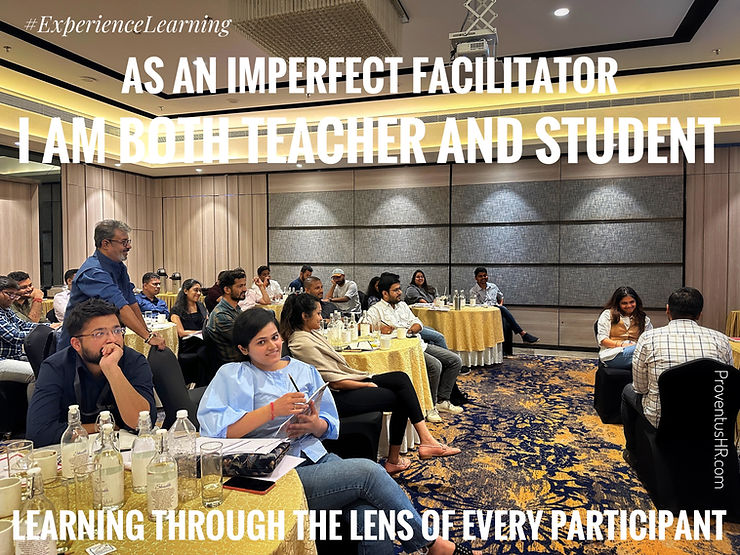
ProventusHR’s REEL|Life methodology uses cinema not as illustration but as instrument. The right film, shown to the right group at the right point in a development journey, does what no case study or facilitation exercise can fully replicate: it creates the felt experience of a developmental challenge before the mind has had time to construct a defence against it.
Ladies First belongs in the ProventusHR REEL|Life portfolio for gender intelligence programmes, Men as Enablers workshops, and senior leadership DEIB engagements for a specific reason: it generates the experience of dissonance in men who would ordinarily resist it. The comedy lowers the defences. The mirror works precisely because the audience did not see it coming. By the time a man realises the laughter was self-implicating, the learning has already entered the room through a door he left open.
The debrief questions that follow are not comfortable. But comfort has never been where genuine development lives. If you are commissioning gender intelligence or allyship work for your organisation and want to understand how REEL|Life can be deployed as the core instrument of that development, the conversation starts with a discovery call.